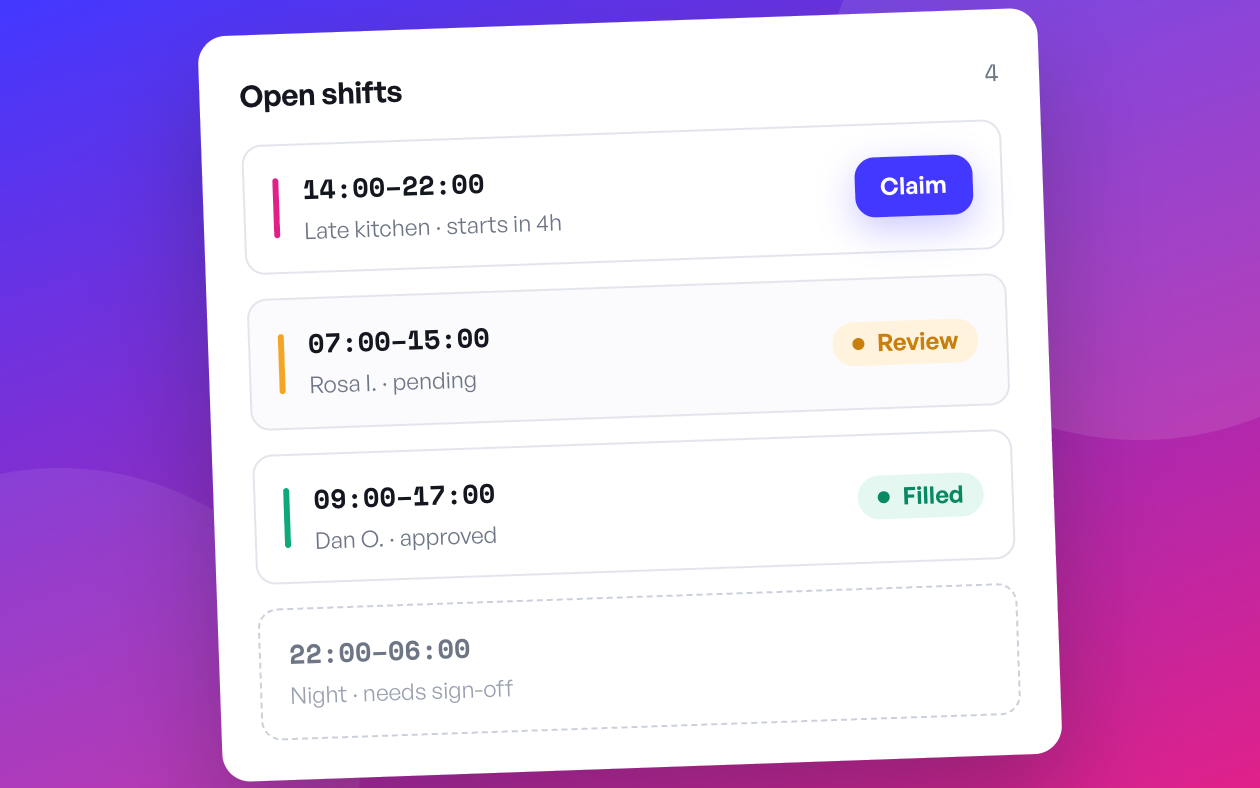
An open-shift board works when it does two things at once: make it fast for employees to grab available shifts, and give managers a way to control who ends up on them. Most boards fail at one or the other. Either they're so locked down that nobody bothers checking them, or they're so open that you end up with the wrong person covering a shift they're not trained for, or scheduled into overtime by accident.
The Core Mechanics
A good open-shift board isn't just a list of empty slots. It needs a few specific behaviors to actually reduce your workload instead of adding to it.
- Visibility by department or role. A warehouse picker shouldn't see open shifts for the loading dock unless they're cross-trained for it. Filter the board so people only see what they're actually eligible to take.
- One-tap claiming. If an employee has to text a manager, wait for a reply, and then get manually added to the schedule, the shift will probably still be open the next day. The claim itself should be instant on the employee's end.
- Manager approval before it's final. Instant claiming for the employee doesn't mean instant confirmation. You still want a checkpoint to catch overtime conflicts, missing certifications, or someone who already worked six days straight.
- A visible status. Claimed-but-pending, approved, or still open — anyone looking at the board should be able to tell which is which without asking.
- An expiration or update rule. If a shift starts in four hours, it shouldn't still be showing as "open" with no urgency flag. Shifts closer to start time should be easy to spot.
Where Open Shifts Come From
The board is only useful if shifts actually flow into it from real situations, and most of those situations are predictable:
- A called-out sick employee. The fastest source of open shifts, and the one where speed matters most.
- Approved time off. Once a time-off request is approved, the shift underneath it should become open automatically, not sit on the schedule looking filled when it isn't.
- Under-staffed periods you added late. A rush of holiday orders or an unexpected event means you need bodies for a shift that didn't exist a week ago.
- A swap that didn't find a direct match. If an employee tried to trade a shift with a specific coworker and nobody bit, releasing it to the wider team is often faster than the swap request sitting unanswered.
What Managers Should Watch
The board removes a lot of back-and-forth, but it doesn't remove your judgment. A few things worth checking regularly:
- Who's claiming the most open shifts. If it's always the same two or three people, you might be quietly building overtime costs or burnout without noticing.
- Whether shifts are getting claimed at all, or just sitting open. If nothing's getting picked up, the problem might be pay, timing, or the shift itself, not the tool.
- Whether approvals are happening fast enough. An open shift approved six hours after someone claimed it isn't much better than one that never got filled.
A board like this doesn't replace scheduling — it's a release valve for the gaps that always show up between the plan and reality. In helloswap, open shifts tie directly into approved time-off and swap requests, so a gap shows up on the board the moment it exists, and claims land in the same approvals inbox as everything else, instead of a separate system you have to check on its own.